Thermal Baths of Bagni di Lucca: A Historic Wellness Destination
10 min.
Water That Has Healed for Two Thousand Years
The springs of Bagni di Lucca have been known for as long as anyone has kept records — and possibly longer. They emerge from the hillside of Corsena above the Lima River at temperatures between 40° and 54°C, rising from fractures in the limestone after a journey of two or three kilometres underground, where the water reaches temperatures of 70° to 75°C before surfacing in a state of extraordinary purity. The chemistry is complex: calcium, sulphate, bicarbonate, silica — a mineral signature laid down over millennia by the geology of the Apennines above.
For the people of northern Tuscany, and eventually for much of Europe, these waters became something close to miraculous. The name of the town is not incidental: Bagni di Lucca means, simply, the Baths of Lucca. The thermal springs are not an attraction here. They are the reason the place exists at all.
A History Written in Water
Rome, the Republic and the First Records
The earliest written reference to the springs at Bagni di Lucca dates to 56 BC, when Julius Caesar, Pompey and Crassus met at Lucca during the First Triumvirate — and, according to tradition, took the waters before dividing their spheres of influence over the known world. Whether or not the generals actually bathed here is a matter of historical inference rather than verified record, but the springs were certainly well established in the Roman period, and the valley's position along ancient transhumance and military routes made them a natural stopping point.
With the fall of the Western Roman Empire, the baths fell into neglect. The valley was abandoned as its inhabitants retreated to the safer heights of the surrounding mountains. It was the Lombards who rediscovered the springs in the early medieval period, but the decisive act of restoration came from one of the most powerful figures of the Italian Middle Ages.
Countess Matilde and the Medieval Revival
In the 11th century, Countess Matilde of Canossa — the great feudal lord who controlled much of central and northern Italy, mediating between popes and emperors with equal authority — ordered the thermal establishments of Bagni di Lucca to be rebuilt and restored. Her interest was not purely medical: the springs lay close to the Via Francigena, the major pilgrimage road connecting northern Europe to Rome, and a functioning thermal establishment represented both a strategic asset and a charitable act. Tradition holds that Matilde ordered the waters to be offered freely to any traveller who arrived in need.
It was also Matilde who commissioned the Ponte della Maddalena — the Devil's Bridge — at Borgo a Mozzano, built to facilitate easier access to the thermal valley from the south.
By the 13th century, the Republic of Lucca had assumed formal control of the spa area, codifying its management in city statutes and beginning to regulate the thermal establishments with the seriousness of a state asset. The Statute of 1308 dedicates considerable attention to the baths; by 1331, an entire chapter was reserved for the proper management of the establishments and the comfort of their visitors. The valley was, by this point, among the most famous thermal destinations in Europe.
The Renaissance: Doctors, Diplomats and Miraculous Cures
During the 15th and 16th centuries, the fame of Bagni di Lucca spread across the continent. Renowned physicians came to study the waters: Ugolino da Montecatini described their therapeutic properties in detail in his 1417 treatise on thermal waters; Gabriele Falloppio — the anatomist whose name attaches to the Fallopian tubes — conducted observations here, famously noting the waters' effects on reproductive health. The legend attached to the Docce Basse spring, which held that women who bathed alone there would return home fertile, ensured a steady flow of hopeful pilgrims from across Italy.
The most celebrated origin story, however, belongs to the Terme Bernabò. In the early 16th century, a wealthy Florentine named Bernabò — afflicted with a severe skin disease and finding no cure in the physicians of his city — arrived at Bagni di Lucca in desperation. Falling accidentally into the muddy thermal waters of the spring on the hill of Corsena, he emerged, according to the story, completely healed. So moved was he by this cure that he financed the construction of the entire establishment that now bears his name.
Montaigne, travelling through Italy in 1580–1581, stopped at Bagni di Lucca and wrote about the springs with the appreciative precision of a man taking his own ailments seriously. Diplomats from across Europe began sending bottles of thermal water as gifts to foreign courts. The valley had become, by the late Renaissance, a place of European significance.
The 19th Century: Europe's Most Fashionable Cure
Nothing in the history of Bagni di Lucca quite matches the extraordinary episode of the early 19th century, when the arrival of Napoleon's family transformed a distinguished thermal resort into the most fashionable destination on the continent.
Elisa Baciocchi — Napoleon's sister and Princess of Lucca — made Bagni di Lucca her summer capital from 1805. She was a woman of considerable intelligence and ambition, and she set about transforming the valley with the authority of a ruler who understood that a great spa required great infrastructure. New roads were built, the thermal establishments were modernised, parks and promenades were laid out along the Lima, and the finest Italian and French architects and engineers were commissioned to extend and refine the existing structures. It was under Elisa's direction that the Bernabò establishment was extended and completed in its current form, in 1812.
Her improvements were well-timed. In the decades that followed, Bagni di Lucca became the destination of choice for the European cultural and aristocratic elite: Byron, Shelley, the Brownings, Lamartine, Dumas, Heine, Paganini, Liszt, Strauss, Puccini, Mascagni. Queen Margherita came. Cardinal Galeazzo Ciano came. The Rothschilds and the Demidoffs — the great Russian noble family who built the hospital that still bears their name in the valley — came and stayed, building villas and establishing a social circuit that had no equivalent outside the great Alpine resorts.
Pauline Bonaparte, Napoleon's other sister and a woman of rather different temperament from Elisa, was among the most devoted regulars of the steam grottos above Bagni Caldi. She visited so frequently that the smaller of the two natural vapour caves was named in her honour: the Grotta Paolina.
This golden age faded gradually in the second half of the 19th century, as the fashion for Alpine resorts drew the aristocracy northward and the social world that had animated the valley dispersed. What remained was the water — unchanged, still flowing, still precisely as warm and chemically complex as it had always been.
The Springs and Establishments Today
Terme Bernabò — The Marble Tub Experience
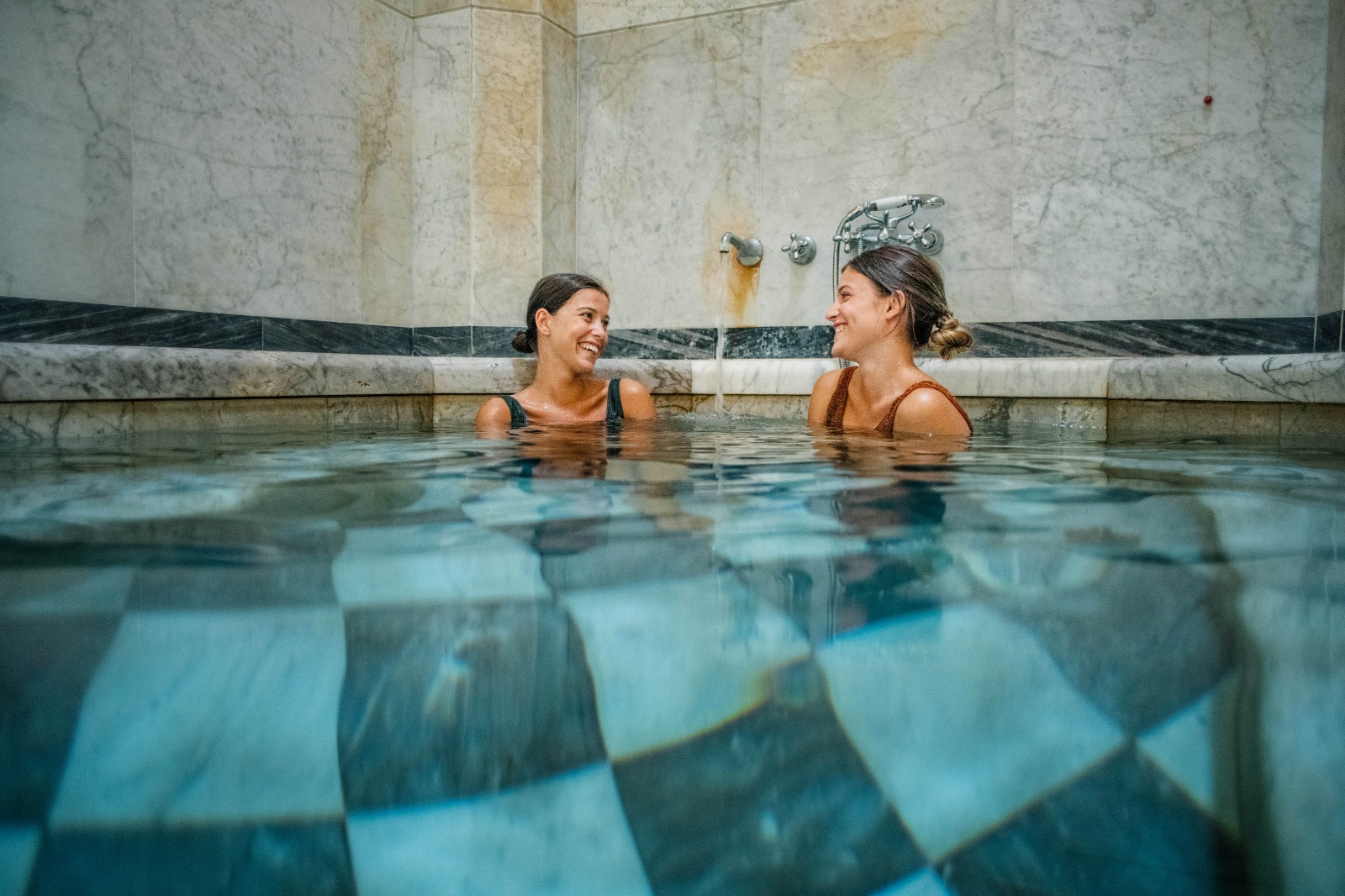
The Bernabò establishment on the hill of Corsena in Ponte a Serraglio is the most complete and atmospheric of Bagni di Lucca's surviving thermal facilities. Restored and reopened after a refurbishment completed in 2006, it offers a spa experience rooted in the 19th-century tradition of the individual marble tub — a room, a bath, water flowing at 39–40°C, and the particular quality of silence that belongs to rooms designed for the body's recovery.
The treatments available include balneotherapy (immersion in the mineral waters, in individual marble baths or in the octagonal communal pool), mud therapy using thermal mud macerated for twelve months in the spring water, Kneipp therapy alternating hot and cold water jets to stimulate circulation, and the filiform facial shower — a gentle, targeted treatment for the skin that the establishment has offered in various forms for over two centuries.
The Steam Grotto is perhaps the most evocative experience on offer: a natural cave filled with thermal vapour at 40–45°C, used since at least the Renaissance for respiratory treatments and muscle relaxation. Stepping into it from the cool air outside is a sensory experience of considerable force — the heat wraps around the body immediately, the vapour closes in, and within minutes the breath slows and something loosens in the chest that ordinary life keeps tightly closed.
Via Bagni Caldi, Ponte a Serraglio. Treatments available on reservation.
The Natural Vapour Grottos of Bagni Caldi
Above Ponte a Serraglio, in the hillside of Bagni Caldi, two natural steam grottos emerge from the rock in a manner that has changed little since antiquity. The Grotta Grande is the larger of the two; the Grotta Paolina, named for Pauline Bonaparte, is smaller and more intimate. Both are fed by the same hyperthermal springs that supply the valley below, their interior temperatures maintained between 40° and 45°C by the continuous release of natural vapour.
The grottos are among only three natural thermal caves in Tuscany, alongside those at Pisa and the Giusti Cave in Monsummano Terme — a rarity that gives Bagni di Lucca a geological distinction beyond its historical celebrity.
The Thermal Pools of Villa Ada
For those seeking a more accessible thermal experience, the gardens of Villa Ada hold three open-air thermal pools filled with spring water, open throughout the summer months. The setting — a 19th-century park above the Lima — combines the pleasures of outdoor swimming with the unmistakable quality of naturally warm mineral water. From a distance, the pools have the slightly surreal appearance of a 1950s film set, an impression that closer acquaintance does nothing to dispel.
What the Waters Treat
The thermal waters of Bagni di Lucca are not undifferentiated: different springs have different mineral compositions and different therapeutic applications, a specificity that the valley's long medical tradition took seriously.
The Bernabò waters — calcium-sulphate, with notable radioactive trace elements — are particularly indicated for skin conditions: psoriasis, dermatitis, rosacea, and the broader category of conditions that the Renaissance physicians grouped under the general heading of "diseases of the blood." The Docce Basse waters, at 42–46°C, have historically been associated with gynaecological treatments and rheumatic conditions. The higher-temperature springs at Bagni Caldi, at 54°C at the source, are the basis of the steam grottos and their respiratory and musculoskeletal applications.
More broadly, the thermal establishment offers treatments for osteoarticular disorders, sports injuries, metabolic conditions, and the general category of what might be called civilisational fatigue — the particular exhaustion of bodies that have spent too long at desks, in traffic, under artificial light, moving too fast through a world that does not encourage stillness.
In this, the waters have not changed their function since the days of Countess Matilde, who offered them freely to weary travellers. They remain, most fundamentally, an invitation to slow down.
Planning a Thermal Visit
Terme Bernabò: Individual treatments are available on reservation, ranging from single thermal baths to full spa half-days combining mud, massage and grotto. Prices are moderate by European spa standards — considerably less than comparable facilities in Switzerland or Austria.
Best season: The thermal experience is particularly rewarding in the cooler months — autumn, winter, and early spring — when the contrast between the mountain air and the warm mineral water is at its most dramatic. In summer, the outdoor pools of Villa Ada offer the most pleasant setting.
Combining with other activities: A morning at the Terme Bernabò combines naturally with an afternoon exploring the 19th-century architecture of Ponte a Serraglio, or with a longer day that takes in the steam grottos, the Casinò Regio and a dinner at the Circolo dei Forestieri — a sequence that, taken together, constitutes as complete an immersion in Bagni di Lucca's historical character as a single day allows.
For guests at La Casa Quieta: The Terme Bernabò and the thermal grottos of Bagni Caldi are approximately ten minutes by car. Guests are welcome to ask for current recommendations on treatments and seasonal availability.
Summary

What are the thermal baths of Bagni di Lucca?
The thermal springs of Bagni di Lucca are natural mineral springs emerging from the hillside of Corsena at temperatures between 40° and 54°C. They have been used for therapeutic purposes since Roman times and are among the oldest and most historically significant thermal establishments in Europe. The main facility is the Terme Bernabò, offering individual marble tub baths, mud therapy, Kneipp therapy and access to a natural steam grotto.
How much does it cost to visit the thermal baths in Bagni di Lucca?
Prices at the Terme Bernabò vary by treatment. A single thermal bath typically costs in the range of €20–€40; combined spa treatments are priced higher. The outdoor thermal pools at Villa Ada are less expensive and open throughout summer. Booking in advance is recommended.
What is the Grotta Paolina in Bagni di Lucca?
The Grotta Paolina is a natural steam cave in the hillside above Bagni Caldi, named after Pauline Bonaparte — Napoleon's sister — who was among its most devoted regular visitors in the early 19th century. The grotto maintains a natural temperature of 40–45°C through the continuous release of thermal vapour, and has been used for respiratory and muscular treatments for centuries.
Who visited the thermal baths of Bagni di Lucca historically?
The thermal baths of Bagni di Lucca attracted some of the most distinguished figures in European history. Literary visitors included Byron, Shelley, the Brownings, Lamartine, Alexandre Dumas and Montaigne. Musical visitors included Paganini, Liszt, Richard Strauss and Puccini. Napoleon's sisters Elisa Baciocchi and Pauline Bonaparte were both regular visitors; Elisa rebuilt the entire spa infrastructure during her reign over Lucca from 1805.
Are the thermal baths in Bagni di Lucca still open?
Yes — the Terme Bernabò is open for thermal treatments on reservation. The outdoor thermal pools at Villa Ada are open in summer. The natural steam grottos of Bagni Caldi have at various times been temporarily closed for restoration; it is advisable to check current availability before visiting.
You might also like ...


A few days in Tuscany can change everything.
Willing to join us? Plan your stay: